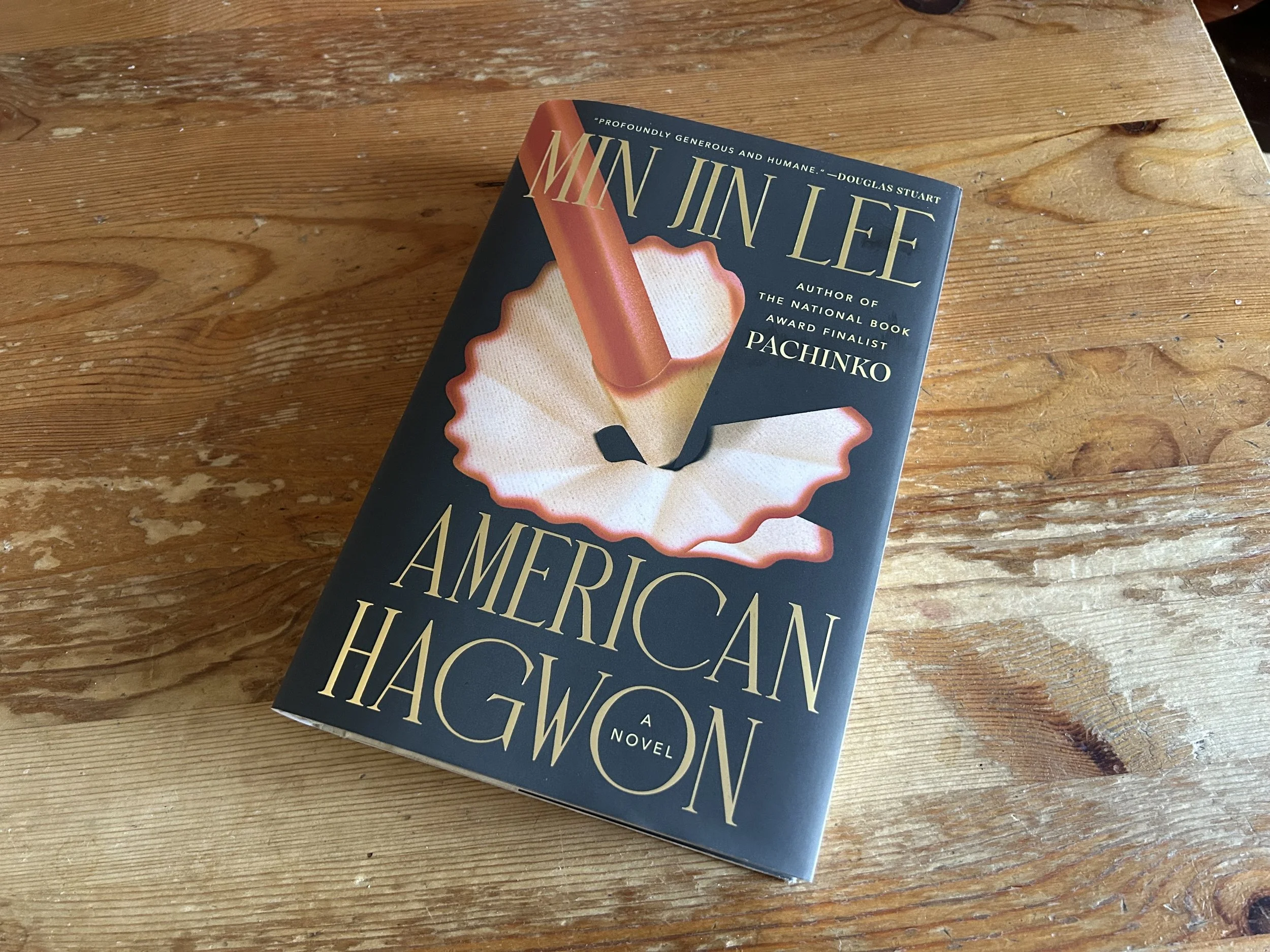
At 9:34 last Monday morning, I learned about the imminent release of American Hagwon. I had had no idea. Min Jin Lee caught me entirely by surprise. I had given up checking for a follow up to Pachinko, a magnificent book, years ago. You can’t wait forever, you know? You have to live your life.
Upon hearing the news, I immediately texted my book buddiest book buddy. “THERE’S A NEW MIN JIN LEE COMING OUT TOMORROW?????” [punctation and capitalization unchanged - ed.] She replied with a photo of the Advance Reader Copy she’d been keeping at her desk for weeks or even months. I used to be hip.
First thing Tuesday morning, I ran into the local Barnes & Noble and picked up a copy. It was a huge book, sticking out even among all the other high-profile August/September releases. You could fit two new Colson Whiteheads in this thing, or nearly three Emily St. John Mandels. I began reading the moment I got home, expecting that to be the rest of my day.
It wasn’t quite. Thirty or so pages in, I found myself happy to be distracted. Sending texts, tidying my desk, fiddling around with a guitar, any excuse to stop reading for a few minutes. That doesn’t necessarily mean the book isn’t working for me; my brain is as fried as anyone’s by modernity. The problem got worse as I continued, though. I was reading American Hagwon through sheer force of will, not any sense of enjoyment. On Wednesday morning at 10:11, I texted book buddy to say, “70 pages in, I see what we’re doing, but I am struggling to get into it as a reader.”
Much as Pachinko tells the story of a Korean family across several generations, American Hagwon follows the five members of the Koh family—parents Helen and John and their teens Bo, DH, and Mido—across fifteen years and three continents. They start the book as well-heeled members of South Korea’s upper-middle class, but a combination of ratfuckery and the East Asian economic downturn of the mid-90s sends them to a significantly more modest existence on the American West Coast.
You can tell even from that cursory description that the book’s big theme is the entropy of life. Our lives are not fully within our control, American Hagwon says. Doing your best, doing what you believe will lead to success, can only matter so much in the face of larger cultural forces, bad luck, or coincidence. This idea permeates the book from the first page to the last. The characters who ultimately find something approaching happiness are those who can embrace where life takes them, who can find a sustaining peace in who they are and what they believe instead of what they do and how much they make.
This is a great, timely theme, one that will certainly resonate with anyone under the age of, oh, let’s say 55, but Lee takes an unnecessarily didactic approach to getting the reader tuned in to its frequency. Every new character, and there are a lot of them, gets introduced with several paragraphs of backstory. We learn where they’re from, what they thought they’d do with their lives, and how they ended up where they are now.
The cumulative effect of this approach is stultifying. Any sense of narrative momentum evaporates when every new character is a speed bump. This approach also makes it extremely difficult for the reader to assign relative importance to the characters, a crucial bit of bookkeeping when reading something with this kind of sprawl. When the tutor Sean was introduced over several leisurely paragraphs on page 46, I thought we were about to spend an entire book together; he’s gone for good by page 60.
A lack of trust pervades the book, trust in the reader and trust in Lee’s own considerable abilities as an author. Themes are spelled out, which isn’t necessary when you have such a perfect marriage of theme and story. That lack of trust extends to the book’s need to include every last relevant inch of its narrative; American Hagwon could easily start 120 pages in and give us glimpses of the events from the first Book. It would certainly be stronger if it had done so.
The book’s other major issue is that the storyline surrounding the titular hagwon, a Korean-style tutoring center, is a total snooze fest. It exists to make a point, not because it is emotionally engaging or intellectually stimulating. Lee uses it to rail against the impossible and dehumanizing standards of the culture surrounding the Korean educational system in particular and status-conscious education in general, to reject the malignant idea that a child is only a success if they get into the very best school. She’s right, of course, but that doesn’t make those pages engaging. By the middle of the book, my eyes would glaze over every time a chapter started at the tutoring center.
That’s in stark contrast to the portions of American Hagwon that focus on the elder Kohs and their cohort (Kohort?). Lee has a natural affinity for and understanding of the older characters. There is a depth to the writing and emotions in these sections that is sorely lacking from the portions focused on the children. The older adults are simply more interesting.
Aunt Sonya, Helen’s sister, is the book’s great triumph. From the moment she first appears, she pops. Lee does her best work when writing about Sonya, her husband Yong-gil, and Yong-gil’s uncle, referred to primarily by his title as the Chairman. These chapters are nuanced, funny, surprising, both poignant and unsentimental. In a book that occasionally caused me to wonder if I’d still like Pachinko, Sonya’s chapters were a terrific reminder of what Lee is capable of. Book V, the final 150 pages, concerns itself almost entirely with the elders, and it is far and away the strongest portion of the novel. I read nearly all of it in one go, glued to a park bench.
The difference in quality between the interleaved halves of this book—neither bad, but one no more than fine—is so obvious and so consistent that I repeatedly wondered where the editor was. This is clearly a case of the author caring deeply about their story; it’s the editor’s job to make the author see the reality of what they’ve written. To me, American Hagwon cries out for the firm hand of a belligerent collaborator, someone who isn’t afraid to insist on cuts.
Lee would only benefit from this. She is prone to spread. Free Food for Millionaires, which I could not bring myself to finish, is 560 pages. Pachinko was 500, and needed every single one of them. I would suggest that American Hagwon isn’t 640 pages because it needs to be; it’s 640 pages out of habit. There’s a world in which editor Reagan Arthur told Lee to tighten the book up, to focus on the parts that so clearly work, a world in which American Hagwon has a different title—it is unfortunate that the book is named after its weakest aspect—and comes in at a tight and excellent 350 or so pages.
I would love to live in that world. The moments when Hagwon shines brightest are those when the author’s concerns are the most immediate and intimate; the death of a loved one, the complex dynamics of mature romantic relationships, or the ways different people navigate national identity, class disparities, and downward mobility. These are epic subjects, but they do not need to be the subject of an epic novel. Sometimes the smaller stories can say even more.