Books

The 102 Best Novels of All Time

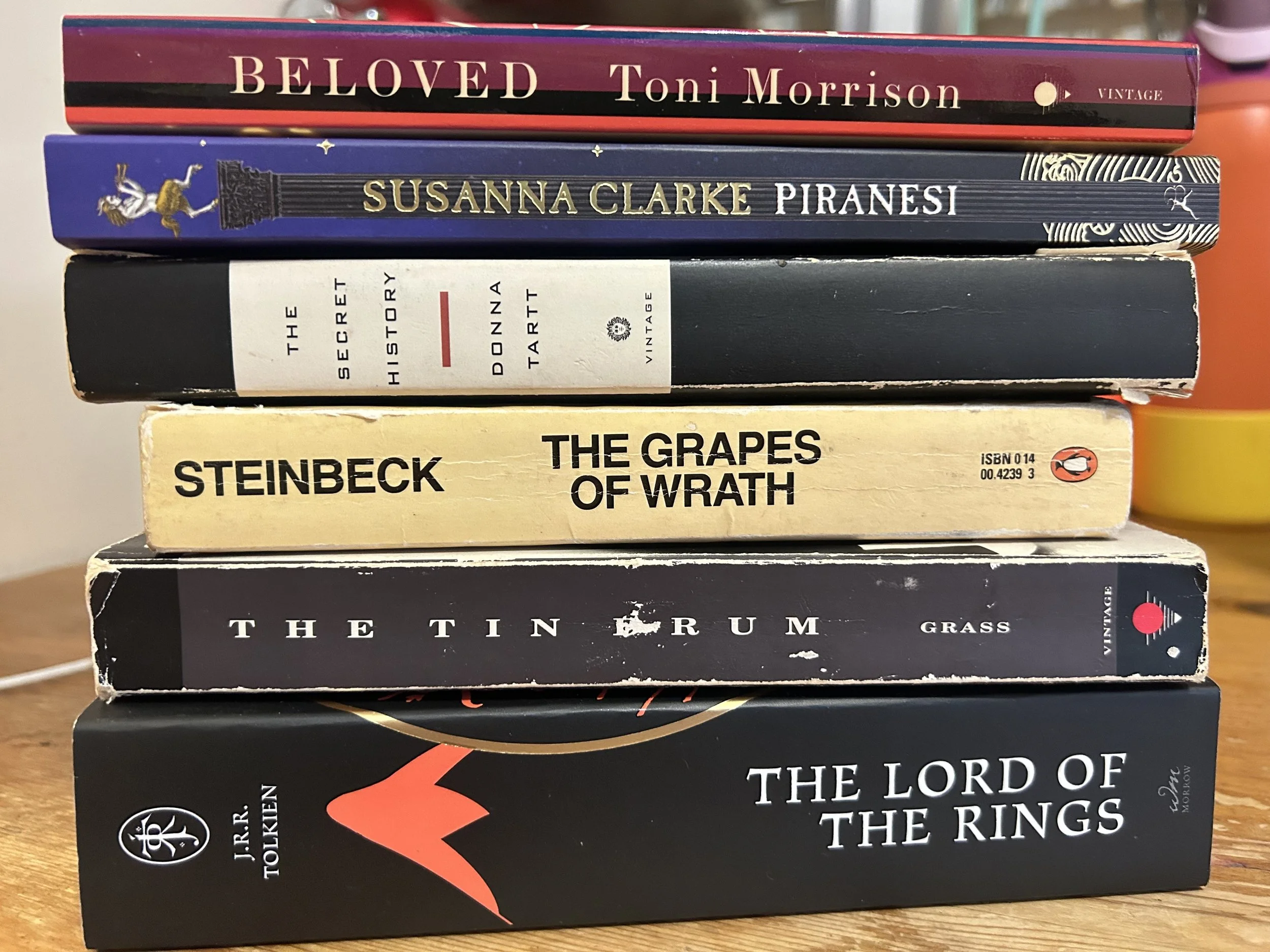
A stack of books, including Beloved, Piranesi, The Secret History, The Grapes of Wrath, The Tin Drum, and The Lord of the Rings

Two months ago, The Guardian published a list of the 100 best novels of all time. You can’t argue with the fidelity to the brief; that is certainly a list of great/Great novels. As a recovering list obsessive whose tween years knew no phrase more exciting than “a new Vh1 video countdown,” I was struck by how bland The Guardian’s list was. How dusty. I suppose any Top 100 list like this is, by definition, an act of aggregation, but it rubbed me the wrong way that it felt so aggregative. Where are the surprises? Where is the personality? Ask anyone with a literature degree to name the 100 most Important novels of all time and I think they’d return something similar.

In the wake of that list, somebody on social media started asking people what three books they would include, and I started forwarding that question on to my friends. I found the responses so interesting, so specific and idiosyncratic, that a new idea quickly took root in my mind: What if I were to poll all of my friends for their Top 10 favorite novels, and aggregate the results into a Top 100 list of my, and our, own? I could then start reading my way through the list, and write about each book as I go. I could talk to the people who included it, and put those friends who shared a book in touch with one another. Why have a small idea and see it to conclusion when you can make it a Herculean task?

It was at this point that my status as a list obsessive shifted from recovering to relapsing. For the better part of two weeks, just about all I could think about was the list. As replies poured in over that first week—and they really did pour in, bless you all—I spent probably an hour every night getting all the new nominations added to my spreadsheet, totaling up the votes.

That may sound dry, but I had an incredible time. Each list was so personal, so interesting. Some were exactly what I expected, and others surprised me. Some were consistently heavy on literary fiction, or genre, and the best ones had a bit of both, like the list that put Pride & Prejudice next to 1970s Soviet-era science fiction. It was so fun to see strange or unexpected overlaps between friends who don’t know each other, or between two friends who do. Do Rebecca and Molly know what book they have in common? Have they ever talked about it?

More than once, I got questions about rules clarifications, or had to referee attempts to weasel out of restrictions. Several short story collections were submitted, though I’m not sure any made the list. One of the first votes was for a webcomic. One friend tried to submit a list of 22 or 23 books, with alternates provided for each slot in the event that I had already read one of them. My insistence that that was not the point of the exercise was met with doubt. Several people seemed concerned with trying to impress me, which is the opposite of the point. Two different people got so excited filling out their ballots that they didn’t put their names in the first box and instead submitted eleven titles. The extra votes stand. One voter misunderstood the assignment, did not realize I was looking for ten books, and, in the process of choosing one, reread the book to make sure it was a suitable choice. I elected to count that vote twice given the effort involved.

The books span from antiquity, or possibly older—does anybody happen to know exactly how old Popol Vuh is—to just last year. The languages represented include Arabic, Chinese, Dutch, English, English (Middle), Finnish, French, German, Greek, Icelandic, Italian, Japanese, K’iche’, Latin, Polish, Russian, Spanish, Swedish, and Turkish. Four ballots only overlap with others once. One ballot, remarkably enough, has no overlapping whatsoever.

Without further ado, the 102 Best Novels of All Time according to my friends, grouped by number of votes:

2 Votes

The Age of Innocence, Edith Wharton

All the Light We Cannot See, Anthony Doerr

The Amazing Adventures of Kavalier and Clay, Michael Chabon

Americanah, Chimamande Ngozi Adichie

Animorphs, K.A. Applegate

Bel Canto, Ann Patchett

Beloved, Toni Morrison

The Book Thief, Markus Zusak

Brave New World, Aldous Huxley

The Catcher in the Rye, J.D. Salinger

Cathedral of the Sea, Ildefanso Falcones

A Confederacy of Dunces, John Kennedy Toole

Contact, Carl Sagan

A Court of Mist and Fury, Sarah J. Maas

Daddy-Long-Legs, Jean Webster

Discworld (Specifically the Tiffany Aching novels), Terry Pratchett

The Dispossessed, Ursula K. Le Guin

Do Androids Dream of Electric Sheep?, Philip K. Dick

Doctor Zhivago, Boris Pasternak

East of Eden, John Steinbeck

Ender's Game, Orson Scott Card

Fishing for the Little Pike, Juhani Karila

Flowers for Algernon, Daniel Keyes

The God of the Woods, Liz Moore

Great Expectations, Charles Dickens

The Great Gatsby, F. Scott Fitzgerald

Havukka-Ahon Ajattelija, Veikko Huovinen

The Historian, Elizabeth Kostova

Holes, Louis Sachar

Housekeeping/Gilead/Home, Marilynne Robinson

The Idiot, Fyodor Dostoevsky

The Invisible Life of Addie LaRue, V.E. Schwab

James, Perceval Everett

Kindred, Octavia Butler

The Kingkiller Chronicles, Patrick Rothfuss

Klara and the Sun, Kazuo Ishiguro

Letters from My Windmill, Alphonse Daudet

The Lies of Locke Lamora, Scott Lynch

Little Women, Louisa May Alcott

Lonesome Dove, Larry McMurty

The Murder of Roger Ackroyd, Agatha Christie

One Flew Over the Cuckoo's Nest, Ken Kesey

One Thousand and One Nights

Outlander, Diana Gabaldon

Persepolis, Marjane Satrapi

Popol Vuh

The Phantom Tollbooth, Norton Juster

A Psalm for the Wind-Built, Becky Chambers

Remarkably Bright Creatures, Shelby Van Pelt

Remembrance of Earth's Past, Liu Cixin

The Road, Cormac McCarthy

The Secret History, Donna Tart

Shades of Magic Trilogy, V.E. Schwab

A Song of Ice and Fire, George R.R. Martin

Their Eyes Were Watching God, Zora Neale Hurston

The Tin Drum, Gunther Grass

Tom Lake, Ann Patchett

Watchmen, Alan Moore and Dave Gibbons

The Wheel of Time, Robert Jordan

3 Votes

The Bell Jar, Sylvia Plath

Broken Earth Trilogy, N.K. Jemisin

Demon Copperhead, Barbara Kingsolver

Dracula, Bram Stoker

Dune, Frank Herbert

Giovanni's Room, James Baldwin

The Giver, Lois Lowery

The Grapes of Wrath, John Steinbeck

Hamnet, Maggie O'Farrell

Lord of the Flies, William Golding

Murder on the Orient Express, Agatha Christie

Never Let Me Go, Kazuo Ishiguro

The Night Circus, Erin Morgenstern

Project Hail Mary, Andy Weir

A Series of Unfortunate Events, Lemony Snickett

The Shining, Stephen King

Slaughterhouse Five, Kurt Vonnegut

This Is How You Lose the Time War, Amal El-Mohtar and Max Gladstone

Tomorrow, and Tomorrow, and Tomorrow, Gabrielle Zevin

A Tree Grows in Brooklyn, Betty Smith

A Visit from the Goon Squad and The Candy House, Jennifer Egan

White Teeth, Zadie Smith

A Wrinkle in Time, Madeleine L'Engle

Wuthering Heights, Emily Brönte

4 Votes

100 Years of Solitude, Gabriel García Márquez

The Egyptian, Mika Waltari

Frankenstein, Mary Shelley

Harry Potter Series, J.K. Rowling

The Haunting of Hill House, Shirley Jackson

The Hobbit, J.R.R. Tolkien

The Hunger Games Trilogy, Suzanne Collins

The Neapolitan Novels, Elena Ferrante

Ready Player One, Ernest Cline

Station Eleven, Emily St. John Mandel

To Kill a Mockingbird, Harper Lee

A Wizard of Earthsea, Ursula K. Le Guin

This is when it starts to get interesting. Station Eleven was, for the first 18 ballots, the clear frontrunner. If it had maintained its rate of four votes for every eighteen ballots, it would have won the whole thing with something like 12-14 votes. Instead, support dried up entirely, and Emily St. John Mandel’s best known book ne’er once troubled the remaining 46 ballots.

The votes for Harry Potter had the opposite distribution. With more than half of precincts reporting, the boy who lived was barely holding on, with only 1 vote for the series as a whole and 1 for The Half Blood Prince specifically (in the name of efficiency, that has been counted as a vote for the series). Two late ballots boosted the series up, and for a brief moment, I wondered if it would hold that momentum in the closing stretch. I would have expected Potter to fare better. I imagine that its relative rarity here is indicative of how badly Rowling has screwed the pooch in regards to the long-term health of her cultural legacy.

5 Votes

The Hitchhiker’s Guide to the Galaxy, Douglas Adams

The Poisonwood Bible, Barbara Kingsolver

The Princess Bride, William Goldman

6 Votes

And Then There Were None, Agatha Christie

Here we hit a small gap. Three votes separate And Then There Were None from the next book, which initiates the Top 3. Watching the race for #1 unfold slowly was one of the chief pleasures of putting all this together in real time. For a little while, And Then There Were None held its own, part of a four-way dogpile, but it fell behind. The fight for #1 became a contest between three books, each of which took its turn in the top slot. I expected two of these to end up in the Top 3, though I would have expected their relative positions to be reversed. As for the other? I didn’t expect quite so many of you to be into Regency novels.

9 Votes

His Dark Materials, Philip Pullman

10 Votes

Pride & Prejudice, Jane Austen

11 Votes

The Lord of the Rings, J.R.R. Tolkien

My original plan was to read all of the nominated books, no matter the number of votes, but by the end of the aggregation period, 64 people had responded, and a total of 425 books had been nominated. With that in mind, we’ll see. But I am excited to read as many of these as I can manage, and to talk to as many of you about them as possible. What form the next stage of this project takes, I’m still figuring out. For now, though, I have to finish reading Middlemarch, which I started when it was at the top of The Guardian’s list. It is, I have to admit, unquestionably one of the best novel I’ve ever read in my life. It’s almost enough to make me rethink my entire Top 10.

Spring, Summer, Asteroid, Bird

The cover of Spring, Summer, Asteroid, Bird, a tan background with traditional screen paintings of trees. It is subtitled "The Art of Eastern Storytelling."

I once joked to a friend that every Miyazaki movie follows a similar trajectory: stuff happens, then five minutes before the end, we find out it was about love the whole time. Miyazaki doesn’t build his stories in the way that we’re used to. Spirited Away, Howl’s Moving Castle, and The Wind Rises don’t break down easily into the three-act structure. They feel truly idiosyncratic.

While Miyazaki’s films are remarkable things no matter your cultural background, his story structures are less unusual when considered within the framework of both Japanese storytelling tradition specifically and East Asian narratives as a whole. Henry Lien’s Spring, Summer, Asteroid, Bird is an introduction to those narratives, exploring East Asian storytelling and what distinguishes it from the West. In particular, he juxtaposes the Eastern preference for four-act and circular structures with the Western three-act. 

The West is so steeped in the three-act structure that many people who don’t spend most of their time thinking about the inner workings of stories are familiar with it. A thing happens. The thing intensifies. The thing resolves. That’s the flow of it. Lien uses Star Wars as an illustration, but just about every story we know and love here in the U.S. of A. adheres to the formula.

The four-act structure is similar. Similar enough, in fact, that it is often treated as nothing more than a variation on the three-act. People exist in a given world. We see them go about their lives in that world. There is a crisis. We see how that crisis and the world come to terms with one another. From that description, you can see how they might be considered two different ways of cutting the same sandwich.

Whether Lien is aware of their interchangeable status, I don’t know. He doesn’t mention it. Instead, he provides a wonderful argument for how and why the structures are distinct, tying them to philosophical outlooks reinforced by the cultures that prefer them. The three-act structure emphasizes the individual, requires a tidy resolution, and necessitates that everything obey the terms laid out in its first act. The four-act structure, on the other hand, emphasizes communities, tends to leave the ending a bit more ambiguous, and allows for so massive a change in the third act that a story may hop genres—consider the tonal shift halfway through Parasite. In point of fact, Lien says, four-act stories are entirely about the impact of that sudden third-act change, and how the world adjusts or doesn’t.

Though Lien missteps early on with some poor choices of examples, and leans throughout the book on a risible short story to illustrate some points, his observations are excellent. There’s a lot to chew on here. Spring, Summer, Asteroid, Bird better equipped me to think and talk about many of my favorite stories, which is a wonderful feeling. I always knew Miyazaki’s movies suddenly become about love in the last five minutes. Now I know why.

The Silence of the Lambs

It was impossible for me to read The Silence of the Lambs in a vacuum. I’ve seen the movie too many times. The book had to exist in conversation with its adaptation, which does seem unfair, the parent justifying their own existence to the child. I was immediately struck by the tone, and the degree to which the movie gets the tone right. There is a quality to the opening chapters, a studied remove, a sense that something nearby (but not here) is wrong. Director Jonathan Demme captured that perfectly. I have no idea how. How do you translate something as ephemeral as texture to a different medium? It’s a magic trick, as far as I’m concerned.

With the book fresh in my mind, I rewatched the movie. It has long been one of my favorites, and the biggest compliment I can pay this book is that I now experience the movie as an adaptation while I’m watching it. Just about everything I love about The Silence of the Lambs, it turns out, comes from the book. Even the way Demme explores the experience of women in male spaces, something that I’ve always understood to be Demme’s own exploration of the material, is right there on the page. The film is remarkably faithful to the source material.

Most, if not all, of the changes are about focusing the material. Jack Crawford, the FBI agent in charge of Behavioral Psychology, no longer has a dying wife, which makes sense. The movie is concerned entirely with Clarice Starling. No need to venture away from that. Exposition is far deadlier in a movie than it is in a book, and a number of adjustments are made to spare the audience an explanation. All in all, it’s entirely successful.

The one thing that suffers in this adaptation? Hannibal Lecter.

It feels as weird for me to say it as it probably does for you to read it. Anthony Hopkins as Hannibal Lecter is an iconic performance, one that still reverberates within culture at large. More people know references to Hannibal Lecter than have seen the movie or read the book. Hopkins won an Academy Award, for god’s sake.

Nevertheless, if there’s one character the 1991 film adaptation of The Silence of the Lambs lets down, it’s the good doctor. A series of small and individually innocuous changes come together to turn Lecter into a bogeyman. In the film, he destroyed his medical records before the FBI arrested him, something the fastidious and studied Dr. Lecter of the novel would almost certainly never consider. It’s an act of impropriety. “Discourtesy,” as he says, “is unspeakably ugly to me.” They were destroyed in the book as the result of a court order, which also feels more in keeping with Harris’s worldview in a way that I can’t entirely articulate.

There’s a scene in the novel where Lecter discusses a fellow inmate with Starling, talking about how the poor fellow has been misdiagnosed by the viscously unpleasant head of the asylum, Dr. Chilton. You get the impression in that scene that Lecter does, to some extent, care about this misdiagnosis, even if it is because the misdiagnosis itself is more of an affront to him than this unfortunate individual being left to live an unnecessarily catatonic life.

The biggest change, a throwaway bit of exposition that explains Lecter’s knowledge of a human head in a Baltimore storage locker, makes it sound like the locker is his. The story is more complex in the novel. Lecter had nothing to do with the head being there. He knew about it through a patient. This isn’t a huge change on the merits, but its impact is profound: Lecter is no longer a terrifying human being, but a beast. He puts heads in the backseats of cars for fun. In the book, Hannibal Lecter is a terrifying man. The movie is content to make him a monster.

As for the book? Magnificent. Within 50 pages, I had stopped thinking about the movie at all. Harris’s The Silence of the Lambs is incredible, full of great writing and memorable scenes. He knows how to do quite a bit with very little. I was sad every time the subway arrived at my destination. For one blissful week, any ten-minute pause in my schedule was an opportunity to make progress. In the last year and a half, I’ve read two other books I loved this much: The Grapes of Wrath and The Poisonwood Bible. That puts The Silence of the Lambs in remarkable company.

A Man's Place by Annie Ernaux

I had a bit of an unusual experience with A Man’s Place, Nobel Prize–winner Annie Ernaux’s 1983 book inspired by her father’s death. I started out reading La place in the original French, in one of those handsome Gallimard editions that are the exact kind of anonymous that I’ve come to associate with luxury goods. I made it about 20 or so pages over the course of a week before deciding I was over it. The writing felt somehow too mannered, too self-possessed, like I was watching a pretentious art film.

I had a copy of the English translation, A Man’s Place, and decided to give that a quick look before ditching the book entirely. I started from the beginning, and a strange thing happened: I was so absorbed by what I was reading that I kept reading, clearing 20 or 30 pages of book while standing at the dining room table. What had initially seemed overly mannered and affectedly brusque in the French suddenly felt like an author maintaining the necessary distance to keep herself together.

I still can’t account for it. The French is not particularly difficult, and the English translation is nearly word-for-word how I myself would translate it were I given the task. Why, then, was this the case? More confounding, when I mentioned the issue to my friend Sara, she told me that over the years she had had multiple friends tell her that Ernaux is best read in translation. These were all French speakers, with a variety of native languages. If anyone has any theories, I’m all ears.

A Man’s Place is about Ernaux’s father. In the process of depicting his life, it cannot help but be about class and family relationships, and how those intersect. The first passage I underlined came some 30 pages into this 90-page book, when Ernaux imagines the moment her parents met. “My mother must have been impressed…when she met him at the rope factory. Before then she had worked in a margarine plant. A tall, dark man with grey eyes, he held himself upright and was a trifle conceited. ‘My husband never looked working-class.’”

Something about Ernaux’s mother using “my husband” while talking to Ernaux about her father struck me as remarkably intimate. It feels proud, warmly possessive, and immensely personal. It’s almost uncomfortable to read. I’m realizing now as I write this that Ernaux never tells us her parents’ names, and somehow that serves to make that passage all the more moving. All we are, all we have, is our relationships with those who love us, and so the people here are defined in those terms.

While Ernaux’s parents began life as working class, they managed to work their way up. They opened a grocery store and café, becoming fixtures of the local community in the process. A lot of the most interesting material here relates to the difficulties that result from successfully achieving what I guess we can’t quite call the American Dream, from managing to make more of your financial situation. Relatives appear from time to time, expecting groceries for free while referring to the pair as superior.

Most touching is the impact their transition has on their relationship with their own daughter. When her father visits her as an adult, “I described the flat, the Louis-Philippe writing desk, the hi-fi system and the red velvet armchairs. He soon lost interest. He had brought me up to enjoy the luxuries he himself had been denied, therefore he was happy, but the antique dresser and the Dunlopillo mattress meant nothing more to him than the signs of social success. He often cut me short by saying, ‘You’re quite right to make the most of it.’” He has spent his life working so she can became a part of a world that holds little for him outside of the aspirational possibility of getting there. “Every time I did well in [school], he saw it as an achievement and the hope that one day I might be better than him.” [Italics hers.]

That theme is even reflected in his language, with frequent references to the ways he would oscillate back and forth between textbook French and his native Brittany dialect. It reminded me of Elena Ferrante’s protagonists in the Neapolitan Novels, individuals who manage a similar upward climb over the course of their lives, who would resort to dialect when angry. We are who we are. We can change the surrounding circumstances, but that doesn’t mean we can change ourselves.


"The Space Between the Notes"

On Every Good Boy Does Fine by Jeremy Denk


At one point in Every Good Boy Does Fine, pianist Jeremy Denk’s wonderful memoir about his years studying the instrument, a professor mentions the old Claude Debussy chestnut, “music is the space between the notes.” I’ve heard the line before, it’s entirely possible you have too, but something about the context here caused it to click.

There are a few competing interpretations of Debussy’s sentiment. One of the most common understands it as advocation for minimalism (not Minimalism, that didn’t exist yet): write as few notes as possible. Emperor Joseph II would certainly appreciate that parsing. “The space between the notes” can be thought of as the literal space on the paper. If we take this as correct, Miles Davis was getting to a similar point when he said that music is the notes you don’t play.

That interpretation serves composers well, but it doesn’t do much for performers. The other interpretation, the one the professor was using at the time, relates to the lateral and temporal distance in between notes. He was talking about the pulse, about rhythm and phrasing.

After reading that chapter, the way I was listening to classical music changed dramatically. I went from passively hearing and appreciating moments of rubato—when a performer stretches a note for longer than indicated by the sheet music—to actively seeking them out. They have suddenly become the key to understanding something bigger. While only time can tell if this fever will settle in for the long run, at the moment I think of the application of rubato as the heart of classical music performance, if not classical music itself.

Look at Krystian Zimerman’s astonishing rendition of one of Franz Schubert’s Impromptus. This has been one of my favorite recordings for nearly a decade now. It is impossibly moving. Zimerman’s technique is impeccable. He is able to separate the voices, the melody and the accompaniment, completely. You would almost believe there were two pianos at work here, one simply plonking out the melody while the other quietly works away. That’s all masterful, sure. What makes this recording sublime, ultimately, is his use of time.

When Zimerman heads for a melodic climax, he milks it. The music slows ever so slightly. It’s almost too much, frankly. Music with too much rubato either becomes camp or, worse, ceases to be coherent. He pushes the freedom of Romanticism right to the edge, but never over. The music breathes. You could play the same passage with identical technique to a metronome, and it would be lovely, but it wouldn’t feel the same. This is the difference between describing a feeling, and embodying it.

Take a listen to Denk’s own recording of the Goldberg Variations. Pay particular attention to those first two measures, and how that music looks on the page. Notice how the left hand notes, the bottom row, always fall squarely in line with a note in the right hand.

The first two measures of the Aria from the Goldberg Variations. The salient detail: all notes in the left hand line up perfectly with a note in the right.

There are many, many recordings of Bach that follow that timing with zealotry. Lord knows I do when I fumble my way through the Aria. With Bach in particular, there’s a pressure to be sehr genau, for everything to be exact. That’s not how Denk plays it, though. In that second measure, he brings in the left hand just a hair, almost imperceptibly, earlier than the right. As a result, the melody pulses with subtle life, a life missing from many otherwise excellent recordings.

To be a performer is a strange thing. You express yourself through the works of others. You have to balance your thoughts, your opinions, and your instincts against their intentions. The space between the notes is the most immediate, and personal, mode of expression musicians have. “Rubato can’t be planned,” a friend of mine said. “That’s the point.” It is an immediate, urgent expression of feeling. In those moments, the boundary between the musician and the sound vanishes.

Every Good Boy Does Fine is an excellent memoir. If you are a music performer, or interested in performance, it is indispensable. It has changed the way I listen to music. Now, the space between the notes is all I can think about.