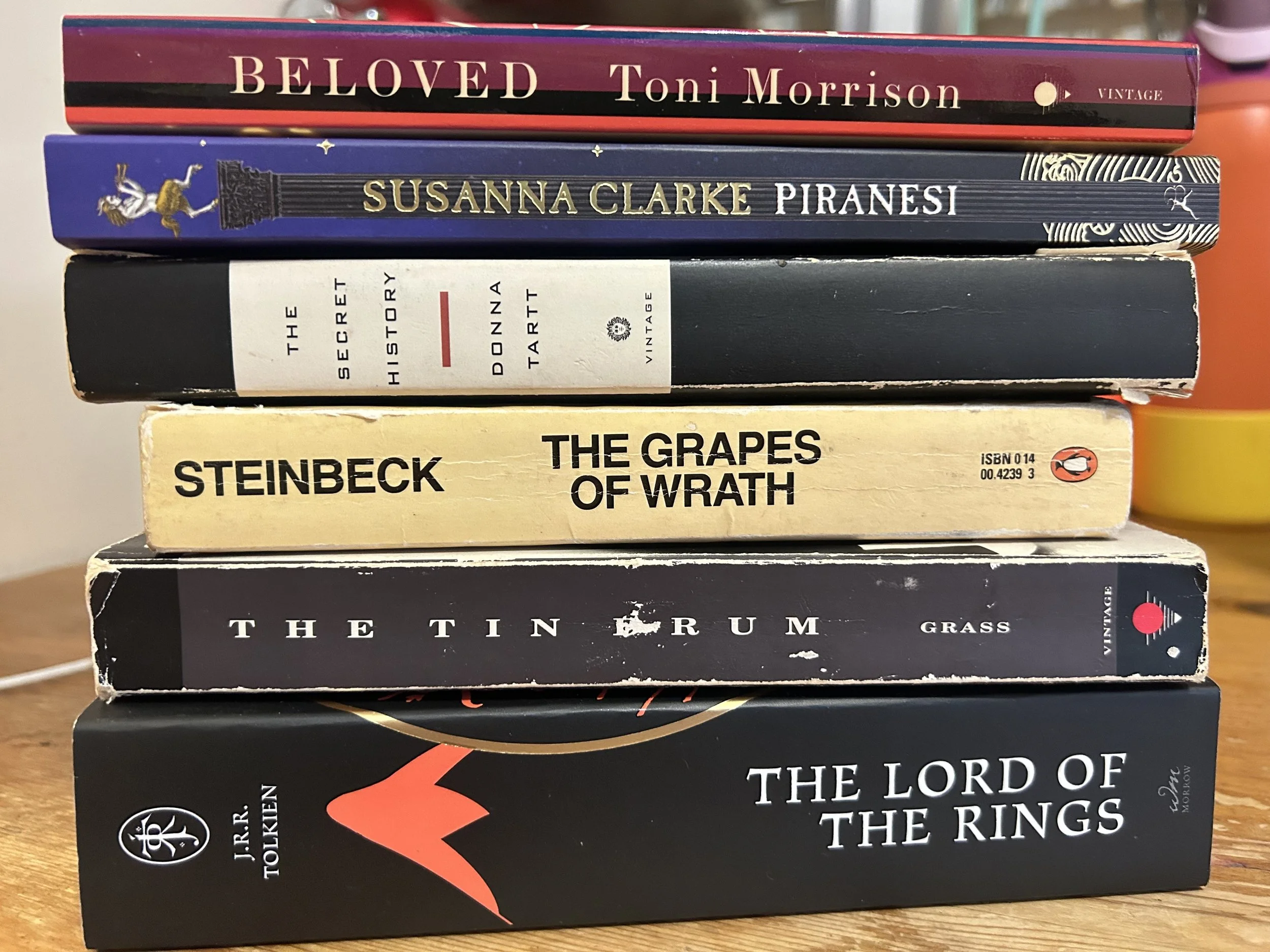
Two months ago, The Guardian published a list of the 100 best novels of all time. You can’t argue with the fidelity to the brief; that is certainly a list of great/Great novels. As a recovering list obsessive whose tween years knew no phrase more exciting than “a new Vh1 video countdown,” I was struck by how bland The Guardian’s list was. How dusty. I suppose any Top 100 list like this is, by definition, an act of aggregation, but it rubbed me the wrong way that it felt so aggregative. Where are the surprises? Where is the personality? Ask anyone with a literature degree to name the 100 most Important novels of all time and I think they’d return something similar.
In the wake of that list, somebody on social media started asking people what three books they would include, and I started forwarding that question on to my friends. I found the responses so interesting, so specific and idiosyncratic, that a new idea quickly took root in my mind: What if I were to poll all of my friends for their Top 10 favorite novels, and aggregate the results into a Top 100 list of my, and our, own?
It was at this point that my status as a list obsessive shifted from recovering to relapsing. For the better part of two weeks, just about all I could think about was the list. I could then start reading my way through the list, I thought, and write about each book as I go. I could talk to the people who included it, and put those friends who shared a book in touch with one another. Why have a small idea and see it to conclusion when you can make it a Herculean task?
As replies poured in over that first week—and they really did pour in, bless you all—I spent probably an hour every night getting all the new nominations added to my spreadsheet, totaling up the votes. That may sound dry, but I had an incredible time. Each list was so personal. Some were exactly what I expected, and others surprised me. Some were consistently heavy on literary fiction, or genre, and the best ones had a bit of both, like the list that put Pride & Prejudice next to 1970s Soviet-era science fiction. It was so fun to see strange or unexpected overlaps between friends who don’t know each other, or between two friends who do. Do Rebecca and Molly know what book they have in common? Have they ever talked about it?
More than once, I got questions about rules clarifications, or had to referee attempts to weasel out of restrictions. Several short story collections were submitted, though I’m not sure any made the list. One of the first votes was for a webcomic. One friend tried to submit a list of 22 or 23 books, with alternates provided for each slot in the event that I had already read one of them. My insistence that that was not the point of the exercise was met with doubt. Several people seemed concerned with trying to impress me, which is the opposite of the point. Two different people got so excited filling out their ballots that they didn’t put their names in the first box and instead submitted eleven titles. The extra votes stand. One voter misunderstood the assignment, did not realize I was looking for ten books, and, in the process of choosing one, reread the book to make sure it was a suitable choice. I elected to count that vote twice given the effort involved.
The books span from antiquity, or possibly older—does anybody happen to know exactly how old Popol Vuh is—to just last year. The languages represented include Arabic, Chinese, Dutch, English, English (Middle), Finnish, French, German, Greek, Icelandic, Italian, Japanese, K’iche’, Latin, Polish, Russian, Spanish, Swedish, and Turkish. Four ballots only overlap with others once. One ballot, remarkably enough, has no overlapping whatsoever.
Without further ado, the 102 Best Novels of All Time according to my friends, grouped by number of votes:
2 Votes
The Age of Innocence, Edith Wharton
All the Light We Cannot See, Anthony Doerr
The Amazing Adventures of Kavalier and Clay, Michael Chabon
Americanah, Chimamande Ngozi Adichie
Animorphs, K.A. Applegate
Bel Canto, Ann Patchett
Beloved, Toni Morrison
The Book Thief, Markus Zusak
Brave New World, Aldous Huxley
The Catcher in the Rye, J.D. Salinger
Cathedral of the Sea, Ildefanso Falcones
A Confederacy of Dunces, John Kennedy Toole
Contact, Carl Sagan
A Court of Mist and Fury, Sarah J. Maas
Daddy-Long-Legs, Jean Webster
Discworld (Specifically the Tiffany Aching novels), Terry Pratchett
The Dispossessed, Ursula K. Le Guin
Do Androids Dream of Electric Sheep?, Philip K. Dick
Doctor Zhivago, Boris Pasternak
East of Eden, John Steinbeck
Ender's Game, Orson Scott Card
Fishing for the Little Pike, Juhani Karila
Flowers for Algernon, Daniel Keyes
The God of the Woods, Liz Moore
Great Expectations, Charles Dickens
The Great Gatsby, F. Scott Fitzgerald
Havukka-Ahon Ajattelija, Veikko Huovinen
The Historian, Elizabeth Kostova
Holes, Louis Sachar
Housekeeping/Gilead/Home, Marilynne Robinson
The Idiot, Fyodor Dostoevsky
The Invisible Life of Addie LaRue, V.E. Schwab
James, Perceval Everett
Kindred, Octavia Butler
The Kingkiller Chronicles, Patrick Rothfuss
Klara and the Sun, Kazuo Ishiguro
Letters from My Windmill, Alphonse Daudet
The Lies of Locke Lamora, Scott Lynch
Little Women, Louisa May Alcott
Lonesome Dove, Larry McMurty
The Murder of Roger Ackroyd, Agatha Christie
One Flew Over the Cuckoo's Nest, Ken Kesey
One Thousand and One Nights
Outlander, Diana Gabaldon
Persepolis, Marjane Satrapi
Popol Vuh
The Phantom Tollbooth, Norton Juster
A Psalm for the Wind-Built, Becky Chambers
Remarkably Bright Creatures, Shelby Van Pelt
Remembrance of Earth's Past, Liu Cixin
The Road, Cormac McCarthy
The Secret History, Donna Tart
Shades of Magic Trilogy, V.E. Schwab
A Song of Ice and Fire, George R.R. Martin
Their Eyes Were Watching God, Zora Neale Hurston
The Tin Drum, Gunther Grass
Tom Lake, Ann Patchett
Watchmen, Alan Moore and Dave Gibbons
The Wheel of Time, Robert Jordan
3 Votes
The Bell Jar, Sylvia Plath
Broken Earth Trilogy, N.K. Jemisin
Demon Copperhead, Barbara Kingsolver
Dracula, Bram Stoker
Dune, Frank Herbert
Giovanni's Room, James Baldwin
The Giver, Lois Lowery
The Grapes of Wrath, John Steinbeck
Hamnet, Maggie O'Farrell
Lord of the Flies, William Golding
Murder on the Orient Express, Agatha Christie
Never Let Me Go, Kazuo Ishiguro
The Night Circus, Erin Morgenstern
Project Hail Mary, Andy Weir
A Series of Unfortunate Events, Lemony Snickett
The Shining, Stephen King
Slaughterhouse Five, Kurt Vonnegut
This Is How You Lose the Time War, Amal El-Mohtar and Max Gladstone
Tomorrow, and Tomorrow, and Tomorrow, Gabrielle Zevin
A Tree Grows in Brooklyn, Betty Smith
A Visit from the Goon Squad and The Candy House, Jennifer Egan
White Teeth, Zadie Smith
A Wrinkle in Time, Madeleine L'Engle
Wuthering Heights, Emily Brönte
4 Votes
100 Years of Solitude, Gabriel García Márquez
The Egyptian, Mika Waltari
Frankenstein, Mary Shelley
Harry Potter Series, J.K. Rowling
The Haunting of Hill House, Shirley Jackson
The Hobbit, J.R.R. Tolkien
The Hunger Games Trilogy, Suzanne Collins
The Neapolitan Novels, Elena Ferrante
Ready Player One, Ernest Cline
Station Eleven, Emily St. John Mandel
To Kill a Mockingbird, Harper Lee
A Wizard of Earthsea, Ursula K. Le Guin
This is when it starts to get interesting. Station Eleven was, for the first 18 ballots, the clear frontrunner. If it had maintained its rate of four votes for every eighteen ballots, it would have won the whole thing with something like 12-14 votes. Instead, support dried up entirely, and Emily St. John Mandel’s best known book ne’er once troubled the remaining 46 ballots.
The votes for Harry Potter had the opposite distribution. With more than half of precincts reporting, the boy who lived was barely holding on, with only 1 vote for the series as a whole and 1 for The Half Blood Prince specifically (in the name of efficiency, that has been counted as a vote for the series). Two late ballots boosted the series up, and for a brief moment, I wondered if it would hold that momentum in the closing stretch. I would have expected Potter to fare better. I imagine that its relative rarity here is indicative of how badly Rowling has screwed the pooch in regards to the long-term health of her cultural legacy.
5 Votes
The Hitchhiker’s Guide to the Galaxy, Douglas Adams
The Poisonwood Bible, Barbara Kingsolver
The Princess Bride, William Goldman
6 Votes
And Then There Were None, Agatha Christie
Here we hit a small gap. Three votes separate And Then There Were None from the next book, which initiates the Top 3. Watching the race for #1 slowly unfold was one of the chief pleasures of putting all this together in real time. For a little while, And Then There Were None was part of a four-way dogpile for the top spot, but it fell behind. The fight for #1 became a contest between three books, each of which took its turn in the top slot. I expected two of these to end up in the Top 3, though I would have expected their relative positions to be reversed. As for the other? I didn’t expect quite so many of you to be into Regency novels.
9 Votes
His Dark Materials, Philip Pullman
10 Votes
Pride & Prejudice, Jane Austen
11 Votes
The Lord of the Rings, J.R.R. Tolkien
My original plan was to read all of the nominated books, no matter the number of votes, but by the end of the aggregation period, 64 people had responded, and a total of 425 books had been nominated. With that in mind, we’ll see. But I am excited to read as many of these as I can manage, and to talk to as many of you about them as possible. What form the next stage of this project takes, I’m still figuring out. For now, though, I have to finish reading Middlemarch, which I started when it was at the top of The Guardian’s list. It is, I have to admit, unquestionably one of the best novel I’ve ever read in my life. It’s almost enough to make me rethink my entire Top 10.