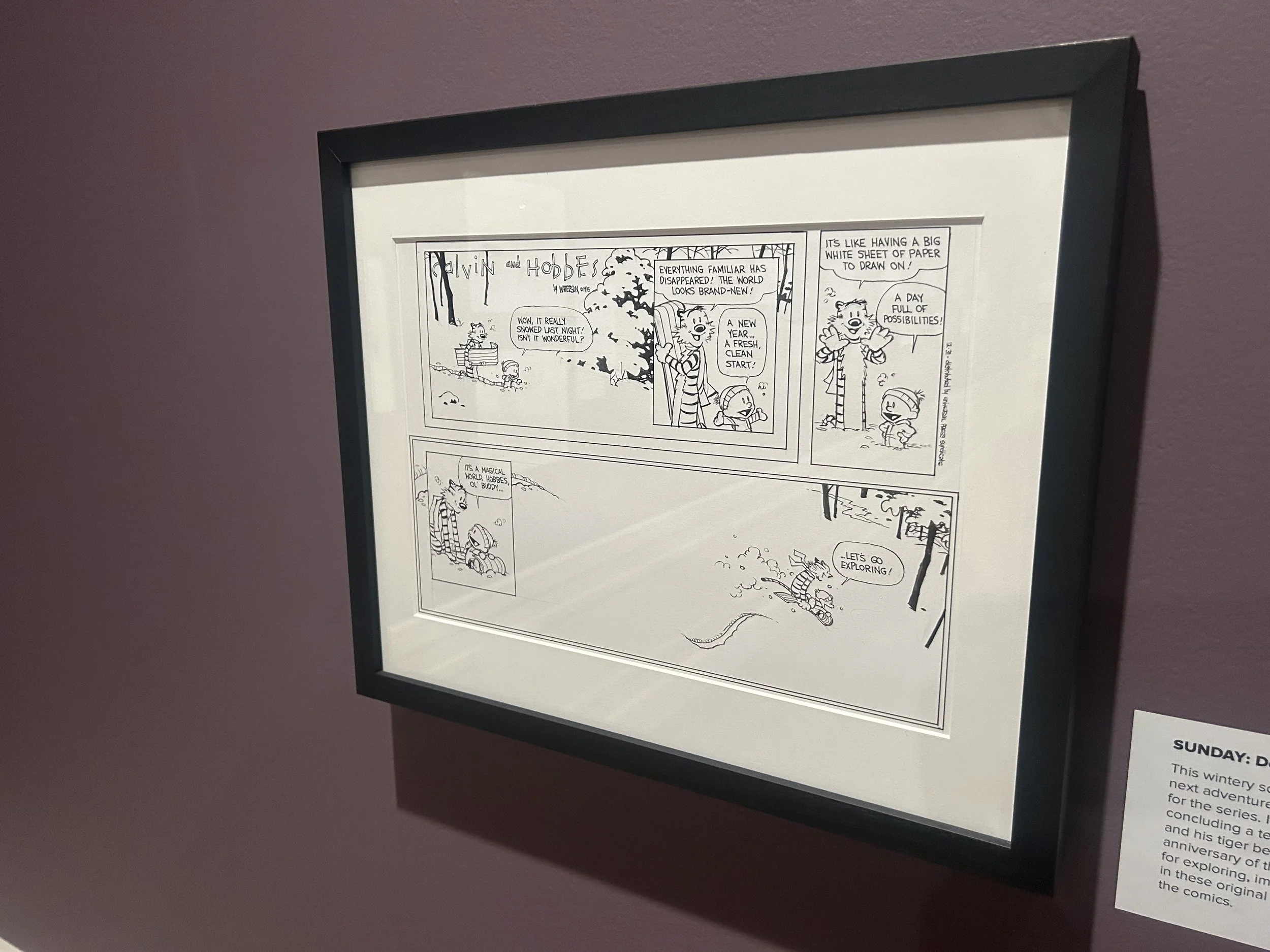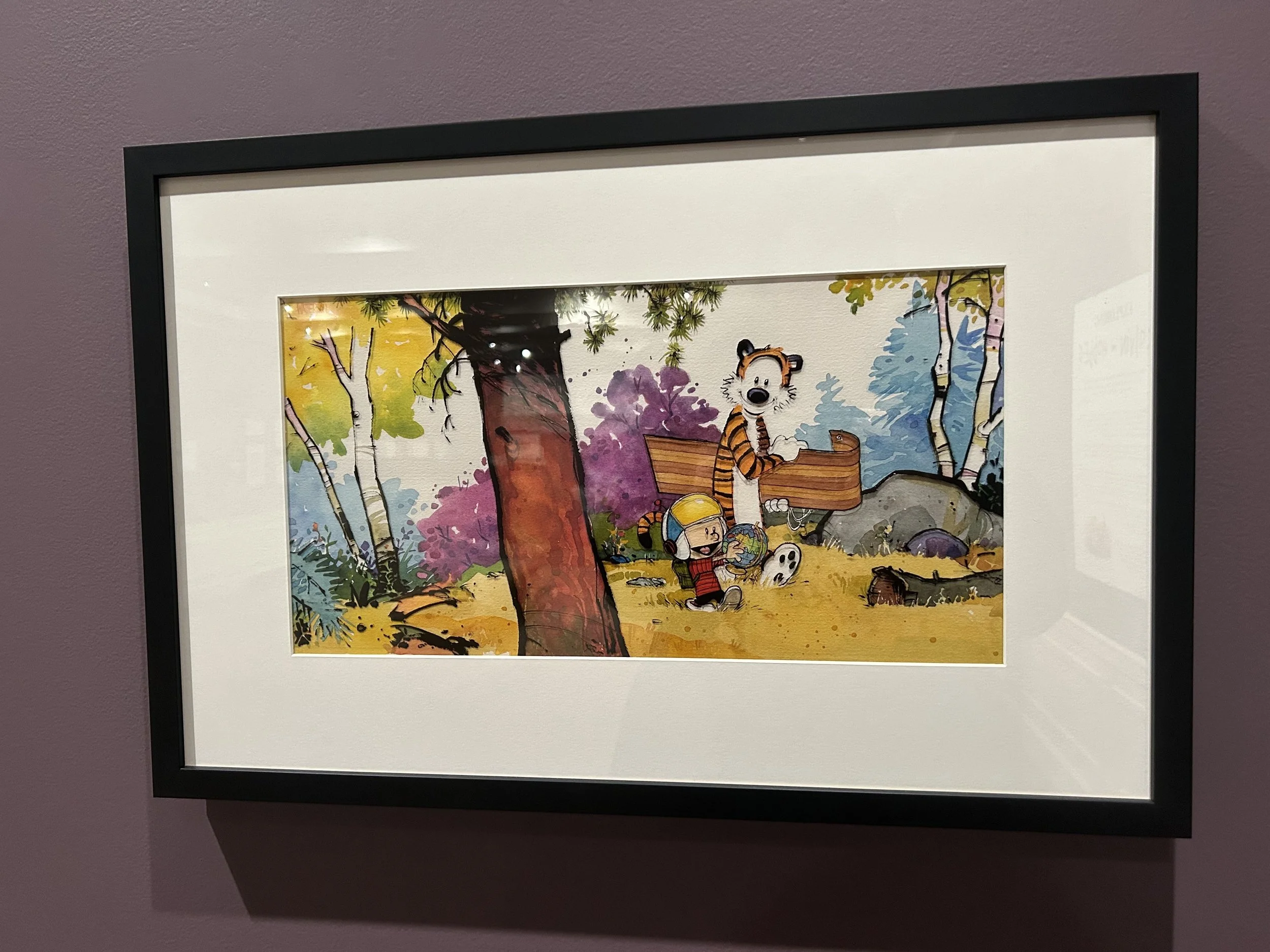
I walked into the Exploring Calvin & Hobbes exhibit at the Fenimore Art Museum on a sleepy, snowy December morning. The weather outside was incidental, but it did add to the mood. My childhood winters were spent either exploring the snow-laden woods around my house or on the sofa, a cup of cocoa in my hand and a copy of The Essential, The Authoritative, or The Indispensable Calvin & Hobbes across my lap.
More than that, Watterson was a profound influence. For a period of time, I wanted to be a comic illustrator, and Watterson more than anyone else was my model. I absorbed his sense of pacing, his paneling, his attention to character. More than that, his dissatisfaction with capitalism, his distrust of authority, and his humanist philosophy all played a crucial part in shaping who I grew up to be. This trip upstate was a pilgrimage.
Looking around, I had to keep reminding myself that these were the original strips. Not in a “pinch me, I’m dreaming” sense, but because it turns out the experience of seeing the original Calvin & Hobbes daily strips isn’t so different from reading them in a book. I went in expecting the work to feel different, like how a Van Gogh in person transforms a serene pastoral image into a violent explosion of texture and color. Then I realized that was stupid. Van Gogh was creating a painting to be seen in person. Photographic replication of an image wasn’t on his radar. Bill Watterson, on the other hand, created Calvin & Hobbes to be printed in newspapers around the world. Like Pop Art, the fidelity of replication is key to the medium.
To that end, boy, those comics were clean. I was anticipating insight into Watterson’s process, dissecting the eraser marks and pencil lines, but there wasn’t much of that. He was and remains a consummate draftsman, and these were neither sketches nor working drafts. The most I got was a slight adjustment to Calvin’s position in the frame, or erased dialogue guidelines, or a bit of grass cleaned up to make the panel more legible. One Sunday strip from January of 1989 showed changes to the angles of Calvin and Susie’s bodies, a successful attempt at heightening the dynamism of their running. That, I say without a trace of irony, was fascinating.
I found the revelations I sought in Watterson’s Sunday strips and his original illustrations for the various C&H collections. The details of the former, the clarity of his line work in a larger format, shine when drained of color. That was particularly true of Sunday strips from the last three years of C&H’s run, when Watterson stopped adhering to the prescribed newspaper layout and let his freak flag fly. I was not thinking of you, dear reader, so I don’t have any photos to illustrate this point. But I promise I’m right.
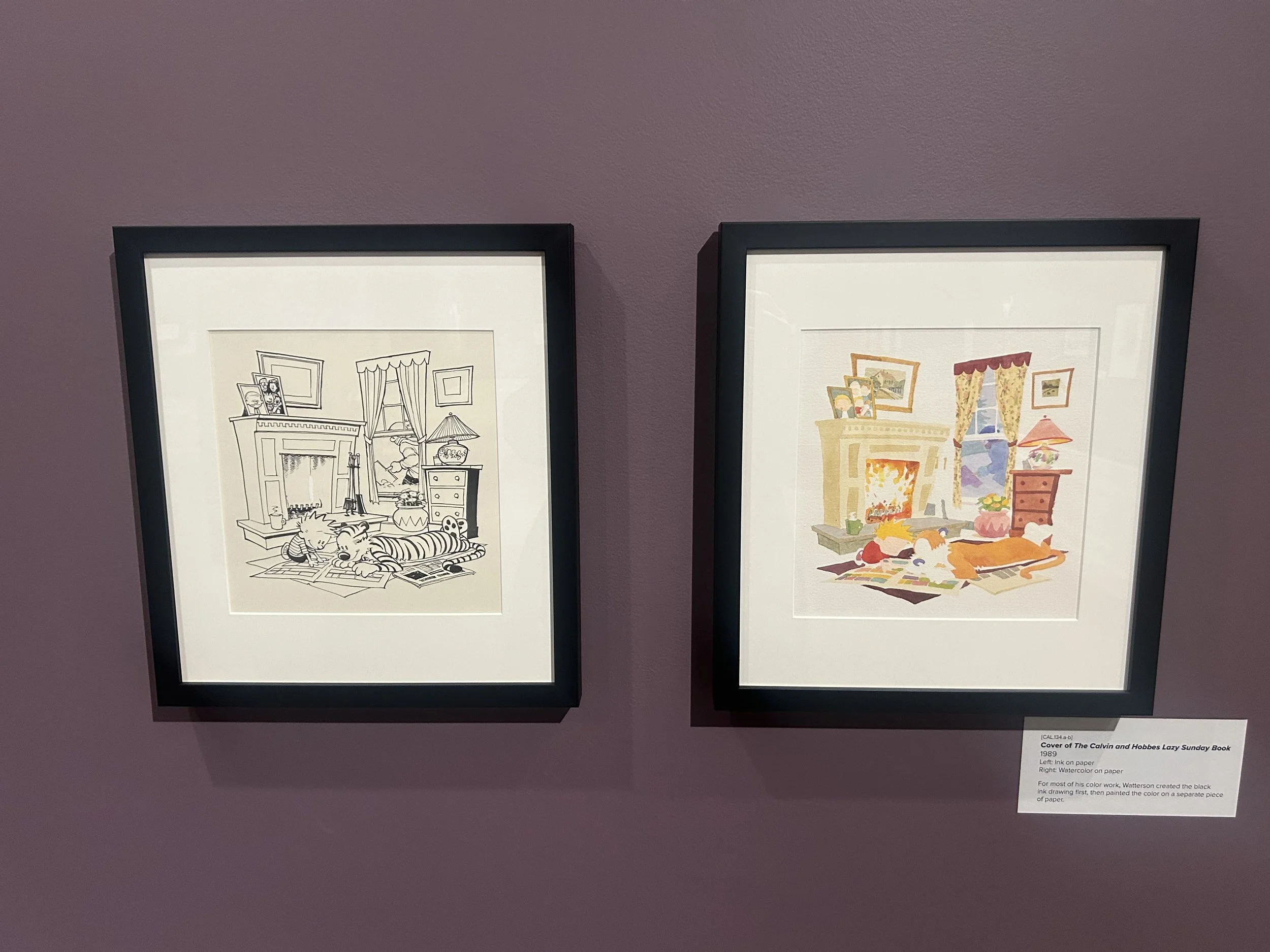
As for those illustrations, my goodness. They were astonishing. If the Sunday strips benefited from stripping the colors away, the watercolors with which Watterson fleshed out his pen-and-ink book covers were Van Gogh all over again. Watterson’s artistry becomes impossible to ignore. The boldness of the colors, the sensitivity with which he depicted nature, the carefully calibrated level of abstraction. I spent a minute or two looking at the watercolors for The Calvin and Hobbes Lazy Sunday Book, an illustration I’ve seen over and over throughout my life. I never noticed before that the room has no corner.
On the way out of the museum, I swung by the gift shop. I wanted a poster, a catalogue, some way to express my enthusiasm through my wallet. I knew I’d be left wanting. For forty years, Watterson has refused to license Calvin & Hobbes for anything. There are no TV specials, no t-shirts, no dolls, no posters. Those once-ubiquitous urinating car decals? Knockoffs. I cannot fathom the amount of money that man has turned down over the years. Not that he needs it.
As a consequence of Watterson’s choices, Calvin & Hobbes is a vanishingly rare thing, a multi-generational, late-20th century cultural phenomenon that exists only as the thing itself. Calvin & Hobbes is not an industry. It does not ask you to define yourself through it. It has no desire that you do so. The very idea likely causes Watterson physical pain. The only way I, you, or anyone else can engage with and celebrate his masterpiece is by sitting down, cracking open a book, and reading.
Or, if you’re lucky, you can visit a museum.