I, like most people, don’t watch the Avatar movies to think. I go to marvel at the technical display, to giggle at the clumsy dialogue and utterly sincere execution of tropes, to clap with glee each time I’m shown a new alien life form or bioluminescent plant. It’s a simple pleasure. Pandora is like AMC: we come to this place for magic.
We certainly don’t come to this place for meaningful experiences. The plots of these movies seem now largely interchangeable. The emotional beats barely register, and when they do, it’s usually not for good reason. It occurred to me while watching Avatar: Fire and Ash that Cameron’s magnum opi are the spiritual successors to the sci-fi novels of the late 1950s and early 1960s. Here too you find tired narrative cliché upon tired narrative cliché, all as an excuse to hang out somewhere.
At least Avatar provides a pretty cool place to hang out. Cameron certainly has ideas, and he has been afforded the time to develop them. There’s a moment of blessed brevity in Fire and Ash when a complex scientific explanation gets cut off, but I’m willing to bet Cameron has a dissertation on the subject in a binder in an office somewhere in New Zealand. The mass of humans on Pandora film major events on portable electronic devices, suggesting there’s a social media of some kind. Cameron can probably tell you about the coding language with which the site was written.
That exhaustive attention to the details of the fictional world makes it all the more strange that Avatar’s real-world racial politics are so muddled. Maybe “politics” is wrong; Avatar is clearly intended to be anti-imperialistic, pro-environment, and pro-“I’d Like to Teach the World to Sing”. Those are solid politics. Its racial praxis is a disaster. James Cameron is evidently a smart, thoughtful guy, but the whiffs just keep on whiffing.
Walter Chaw’s scathing review over on Film Freak Central goes into great detail about this. I don’t agree with everything he says—“check in on your minority buddies” assumes a monolithic minority response that the box office numbers simply don’t back up—but it’s hard to argue with the larger points. Avatar as a series reinforces the idea of the mystical, naïve native. It invests most of its character development in the two white men who were swapped into Na’vi bodies. It appoints one of those two white men the savior of the species. Just about all of the Na’vi are played by white actors doing vaguely “ethnic” accents of one kind or another, which come to think of it makes no sense, shouldn’t the two humans in Na’vi bodies have the accents? Anyway.
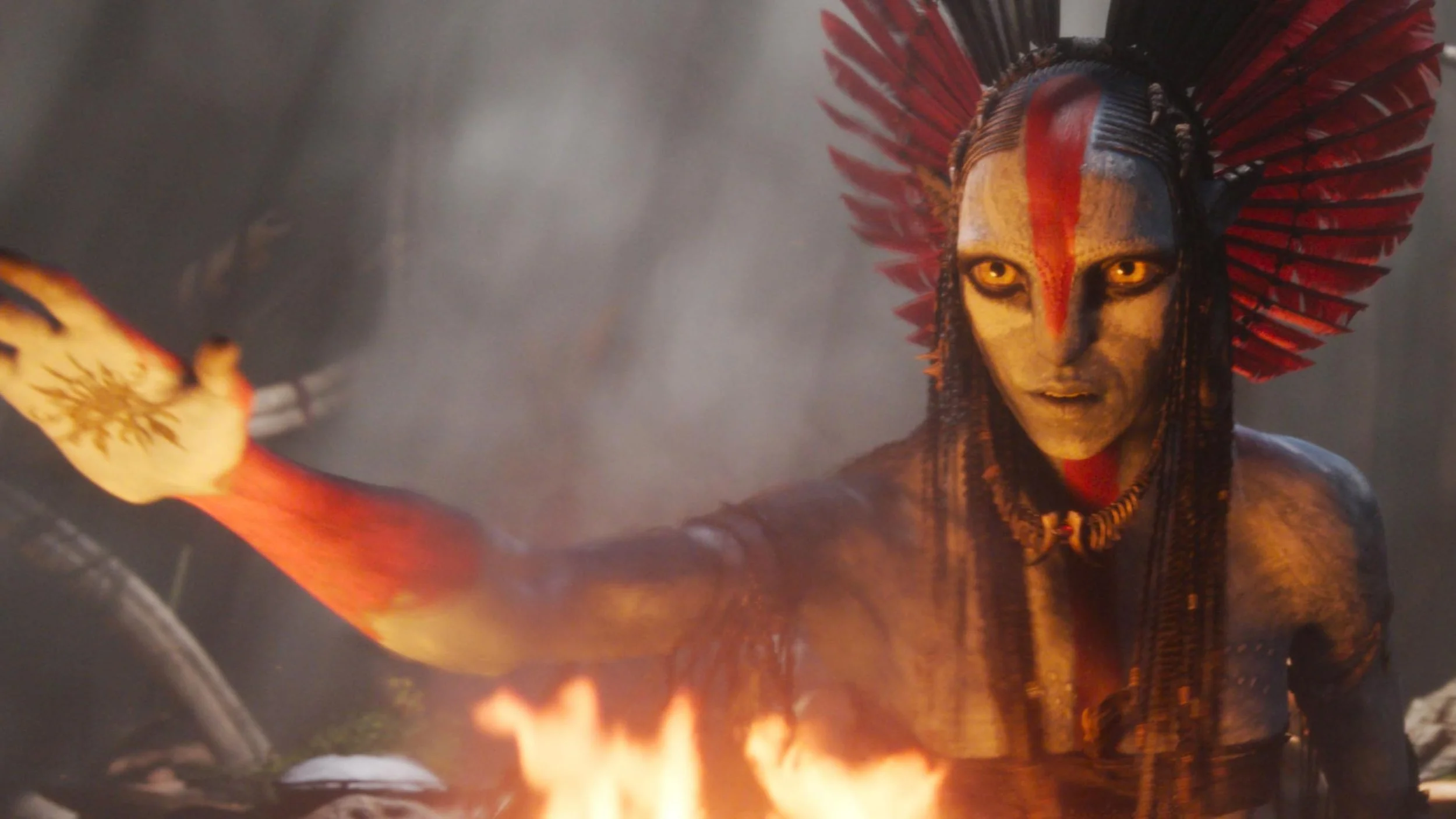
Within all this context, I’ve been thinking particularly about Varang, the new villain. She lives on the side of an active volcano, in an ash-covered tent only Georgia O’Keefe could do justice. She and her tribe feel notably different, the first ignoble Na’vi we’ve seen. She’s murderous, violent, impulsive, and seems incredibly smart. Self-sufficient, at least. Resourceful. Brimming with agency. She lives on the side of a volcano because an eruption destroyed her tribe’s home. Despite all her prayers, the great spirit of Pandora, Eywa, never sent help. Hers is a story of faith spurned.
I love that. It’s the kind of idea that only emerges when writers fully engage with their worlds. It makes everything about Pandora feel more alive, and it starts the work of filling in the gaps around some of the stereotypes Avatar otherwise uncritically trucks in. Varang experienced a profound violation of her beliefs and came out the other side having made a decision. That she calls guns “thunder” is boring and offensive (like…they have a word for “weapon,” James), but it’s easier to stomach because she is a full, complex character.
Then, halfway through the movie, she is stripped of her agency. She becomes human/Na’vi hybrid Miles Quaritch’s Crazy Girlfriend™, little more than a background character. Instead of a defined individual with her own interests, Varang regresses to a tall and blue version of Pom Klementieff’s character Paris from the Mission: Impossible franchise. That alone is not inherently a problem; Paris is one of the best parts of Dead Reckoning - Part One. But Paris is never more than a fun supporting character. Varang promises so much more in the early stretches of Fire and Ash. To strip her of that depth is to leave both her and the Na’vi as a whole poorer.
The problem with Avatar, to me at least, isn’t that Cameron draws the Na’vi from Native American and other indigenous cultures, right down to that little apostrophe. The idea that certain stories can only be told by certain people is not one I agree with. I do, however, think it is incumbent upon anyone who steps outside their realm of expertise to do the work. The issue as I see it is that Cameron pours all of his attention into the two human characters. The Na’vi are offensive and patronizing caricatures and they’re poorly realized characters. Cameron cares a great deal about Pandora, about the mythology and biology and technology of this reality he has created. He clearly cares tremendously about the Na’vi as a people, as an abstract and collective entity. It seems like he doesn’t care all that much about the Na’vi as individuals. They’re an idea. That can work in some contexts. It’s a tough pill to swallow when they’re drawing from real humans who have also so often been denied the same individuality.