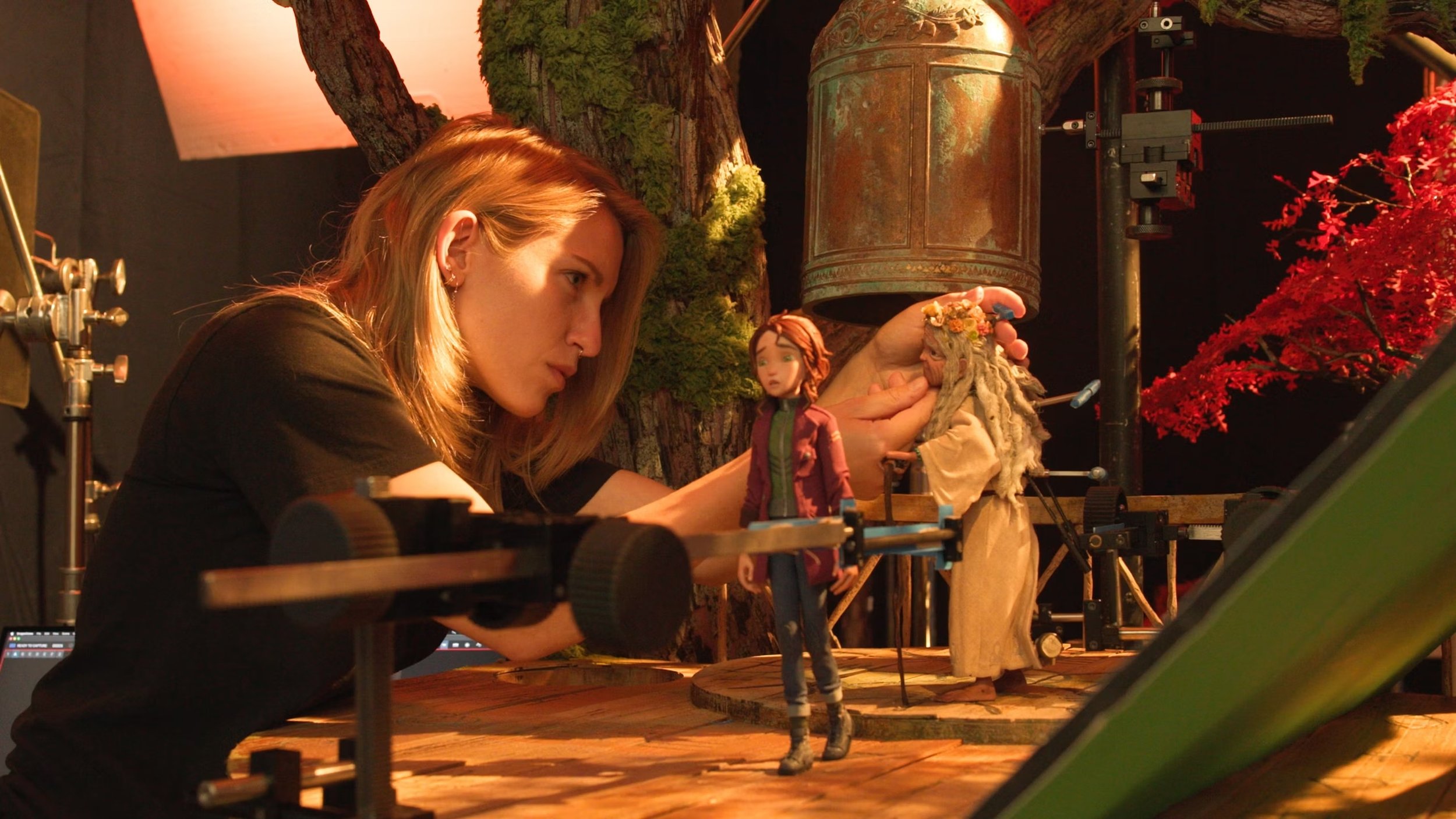
For those who love them, the stop-motion films of Studio Laika are a balm. Ever since Coraline came out in 2009, the Oregon collective has been committed to pushing stop-motion to its absolute limits, and for that they have been rewarded with a small but fervent group of devotees. You can usually spot the faithful in day-to-day life; they’re the people knitting on the train, crocheting at the airport, or talking in breathless tones about their new Cricut.
The techniques and the care that go into their films are astonishing. Heads of hair are created one strand at a time. Every distinct face gets 3D printed. If you see a character wearing a knitted hat, somebody knit that at scale. This is to say nothing of the animation itself, a self-flagellating act of creation in which animators spend untold hours making the tiniest adjustments possible at 24 frames per second. On a good day, on a great day, an animator might produce 5-10 seconds of finished footage. It’s mind-boggling.
This slavish devotion to a grueling art form is why people are in turn slavishly devoted to the studio. People love Studio Laika because, in a world obsessed with doing things as quickly and cheaply and friction-free(ly) as possible, they insist on making movies in as time- and labor-intensive a manner as exists. From the outside, they do so while unbothered by the forces of commerce, chipping away at a story heedless of the time and the money. It’s romantic. They represent a way of doing things that capitalism does not afford most of us (because most of us are not the sons of Nike founder Phil Knight). If you are of a certain disposition, watching a Studio Laika film is a form of wish fulfillment.
Wildwood, their first film since 2019’s Missing Link—a movie that has itself become something of a missing link in their filmography—is Studio Laika’s most ambitious project by a wide margin. The studio spent six years making it, developing a dizzying array of new puppetry technologies in the process. The sheer scale of the thing is enormous, with hundreds of characters, dozens of sets, and a blockbuster-scale battle scene straight out of The Lord of the Rings or Dune.
Going into Wildwood, I hoped I would enjoy the story, but I wasn’t staking any money on it. Studio Laika is tremendous at producing stop-motion, but they are not so good at producing movies. With the notable exceptions of Coraline, the first 60 minutes of ParaNorman, and Kubo and the Two String (which even I, a big fan, will admit is mostly about the vibes), their filmography is riddled with visually ravishing films that are otherwise unmoving. I went into Wildwood to marvel at the craft.
Instead, to my surprise, I felt a bit numb. The movie is, inarguably, an astonishing technical achievement, but I had to keep reminding myself that it wasn’t CGI. The advancements Studio Laika has made over the past twenty years have been applied to making the process of stop-motion itself invisible. New materials mean the boiling and chattering that betray the animator are now a thing of the past. Compare any recent Studio Laika film to Wes Anderson’s The Fantastic Mr. Fox and Isle of Dogs, which revel in the constant roiling of hair and fur that results from adjustments to the puppets. There, the process is part of the aesthetic. Studio Laika has moved in the opposite direction.
For my money, Wildwood renders the process too seamless. The stop-motion is now so perfect that it is indistinguishable from computer animation. This isn’t helped by the liberal application of digital post-production tools in enhancing backgrounds. It introduces just enough plausible deniability to any and every frame that I can’t get lost in the craft because I find myself doubting it. Is that flock of crows actually stop-motion, or are they digital clones? What about the flower that opens in the main character’s hand? The leaves on the vines during the climactic action sequence?
If those things were digital—which I’m absolutely not saying they are—I couldn’t really blame Studio Laika for that. It would be disappointing, but the answer isn’t what matters here. This is about the distance created by the existence of the question in the first place. Something has changed in the ten years since Kubo and the Two String, when I watched in awe as a boat was made entirely of leaves without even for a moment questioning it.
I’m sure AI doesn’t help. We’ve all spent the last year or two needing to subconsciously vet every image we see. I’ve been primed to doubt. And that’s a real shame. Studio Laika doesn’t deserve that. The ethos of craft they embody is the antithesis of what AI seeks to do. I don’t deserve to live in that world either. Neither do you. That way leads to the death of wonder.
You know what I’ve been having an absolute ball with, though? YouTube is littered with behind the scenes videos about Wildwood’s production. I could watch those all day. Inject sped up videos of the animation process, the ones where the animators appear in blurred moments before evaporating, straight into my veins. Hell, make the next movie entirely like that. I know I can trust it. There’s no question that what I’m seeing is real.