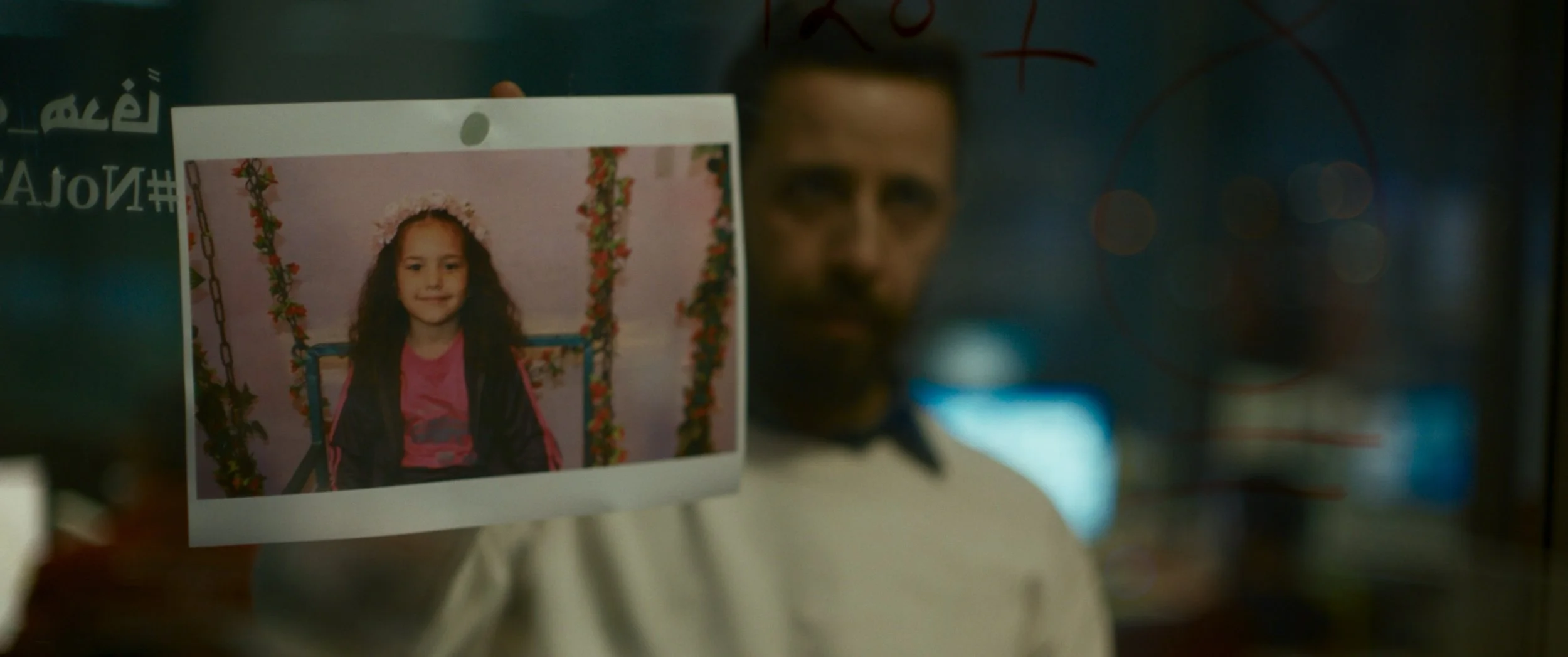
In January of 2024, five-year-old Hind Rajab was one of seven passengers in a car in Gaza that came under fire by the Israeli military. Six of those passengers, all members of her extended family, died immediately. Hind spent the next several hours on the phone with workers at a Palestinian Red Crescent (PRC) call center as they tried to coordinate her rescue. You may remember the story, which was all over social media at the time.
The Voice of Hind Rajab focuses on the people in that PRC call center. Shot almost entirely in close-up, it is a claustrophobic portrait of desperation in the face of impotency. The actors have nothing to hide behind. We look them in the eye for the duration of its 90 minutes. At times, I found myself thinking about how emotionally exhausting the process of making this thing must have been.
Writer and director Kaouther Ben Hania makes extensive use of real audio recordings provided by PRC. Any voice you hear through a phone in The Voice of Hind Rajab is a primary source recording. Hind is never seen, and never portrayed. She exists only as her real voice and a trio of photographs. There’s a world where this use of genuine audio becomes a cheap gimmick, but Ben Hania is smart about it. We occasionally hear snippets of the real-life call center employees portrayed by the actors, and at times both versions of their audio, the real and the pretend, are woven together. It is grounding, done just often enough to remind you that this is a real thing that happened, as though The Voice of Hind Rajab were concerned that the audience might grow too settled, too lost in the idea that this is a fiction.
In order to get Hind out, PRC has to navigate the bureaucracy of the oppressed, abiding by rules that were imposed on them. One of the coordinators, Mahdi, explains it to Hind’s uncle on the phone: It takes us 8 minutes to get to Hind, but we have to get approval from Israel, whom we cannot speak to directly, so we have to speak to The Red Cross, who then speaks to the Israeli government, who then gets back to The Red Cross, who gets back to us, and then that whole process has to start over so that we can get approval to actually go.
This is as close to Politics as the film gets. Ben Hania is making a humanist argument. How can it be that the words “There is a five-year old child stuck in a car, surrounded by the corpses of her family,” are not sufficient to stop everything? How can anyone get so consumed by self-certainty that they no longer hear the reason at the heart of even that? Omar practically says as much when he suggests they tell the Israeli military she’s there. “Tell them she’s there. She knows where her home is. Get her out, take some photos for their propaganda, and let her go.”
In between the moments of interpersonal disagreements on method and approach are the calls with Hind. The call center employees pour all of their energy into keeping her calm. At one point, a woman named Rana leads Hind in a recitation from the Quran. It’s an incredible performance from actor Saja Kilani. In the real audio recording, you can hear Rana barely managing to keep it together. The prayer she chooses for them to recite is contextually heartbreaking:
In the Name of God, the most Beneficent, the most Merciful.
All praises by to God, the Lord of the worlds.
The most Beneficent, the most Merciful.
The owner of the day of judgement.
You alone we worship, and you alone we ask for help.
Guide us to the straight path.
The path of those you have favored.
Not the path of those who have earned your anger,
Nor of those who have gone astray.
Amen.
This is faith’s only appearance, this illustration of its value as something to comfort and to give hope, and as something that unites a people. The audio of a five-year-old child dutifully reciting the prayer is crushing. “Well done! You’ve memorized it,” Rana praises. Hind immediately returns to panic. “Please come,” she says for probably the hundredth time.
We follow the ambulance’s location on a map. As it drew closer and closer to the gas station where the car was waiting, I was filled with the terror of knowing the story without remembering how it ends. Maybe I was wrong. Maybe it does work. In the Name of God, the most Beneficent, the most Merciful, guide us to the straight path, the path of those you have favored.
Despite following the rules laid out for them, despite doing everything by the book, despite getting approval from the Israeli military for an extraction, the paramedics don’t make it. They were firebombed mere meters from the car. There are so many tragedies in The Voice of Hind Rajab. The sharpest may be that the Palestinians did everything the way they were supposed to, and it still wasn’t enough to save her, to save the lives of those paramedics, to stop the deaths of another 70,000 or so Palestinians.
There are always questions around a work of art like this, something this resoundingly of its moment. Is The Voice of Hind Rajab as good as it seems? Are people not responding to it positively out of a sense of obligation or performance? Is it in bad taste? I don’t know. Certainly, my experience was intensified by the weight of complicity that comes with being an American. Ten years from now, I hope we’ll have the distance from these events necessary for me to be able to ask myself that. Until then, I can only tell you that I am full of fury and sorrow. May we never forgive, and may we never be forgiven.